
Anyone can buy a .com. A .us name is different, because the registry checks who you are.
The US domain name requirements come down to one rule: you need a real link to the United States. This guide shows who qualifies, what you must provide, and how to avoid losing a name you just paid for.
The price is small. A tracker updated on November 11, 2026 showed average first-year prices near $13.80, so the bigger risk is a name cancelled with no refund.
What Is a .us Domain?
The .us extension is the country code domain for the United States. Individuals, companies, schools, and agencies use it to show where they belong.
Older guides name Neustar as the registry. On October 1, 2026, the US government chose Identity Digital to run it, according to Domain Name Wire.
The change of operator does not rewrite the rules below. Eligibility comes from the usTLD policy, whoever runs the registry.
Why People Choose .us
A .us name tells American visitors that you are local, which can build trust. It also gives you more naming choices, since short .com names are often taken.
Businesses with a US base use it to match a real address to a web address. It works well for local services, US-only stores, clubs, schools, and agencies.
The Nexus Rule: The Core of US Domain Name Requirements
Nexus means a real connection to the United States. The usTLD Nexus Requirements Policy sets three categories, and you must fit at least one.
| Category | Who qualifies | What you state |
| Category 1 | A US citizen, a permanent resident, or a person whose main home is in the US or its possessions | Your status as a citizen, resident, or domiciliary |
| Category 2 | An organization formed under the law of a US state, the District of Columbia, or a US territory, including government bodies and US non-commercial groups | That you meet the nexus rule |
| Category 3 | A foreign organization with a real presence in the US | Your country of citizenship, plus your US activity or office |
Category 1: Individuals
You qualify if you are a US citizen or a green card holder. You also qualify if your primary home, called a domicile, is in the US or one of its possessions, such as Puerto Rico or Guam.
Category 2: US Organizations
Any organization formed under US law can qualify, wherever its team works. That covers these groups.
- Corporations and LLCs
- Partnerships
- Non-profit and other non-commercial groups
- Federal, state, and local government bodies
Category 3: Foreign Organizations With a US Presence
A foreign business can qualify when its US presence is real and lawful. The policy gives two examples: regular activity in the US, such as selling goods or services, or an office or other facility there.
The activity cannot exist only to win a .us name. If your link is a few online sales, ask your registrar before you pay.
A Quick Eligibility Check
Answer these in order and stop at the first yes.
| Question | If yes |
| Are you a US citizen, a green card holder, or based in the US? | You fit Category 1 |
| Is your organization formed under US state or territory law? | You fit Category 2 |
| Does your foreign organization have a real US office or regular lawful US activity? | You fit Category 3 |
| None of these? | Choose a different extension |
Write down your answer and the reason. You will need the category at checkout.
What You Must Provide When You Register
Forms differ between registrars, but the policy lists the same core items. Missing any of them gets the order rejected.
- Contact details. A name, postal address, email, and phone number for the owner and contacts.
- Your nexus category. Category 1, 2, or 3.
- A nexus statement. A declaration that you meet the requirement.
- Proof of status for Category 1. A statement that you are a citizen or permanent resident.
- Citizenship for Category 3. The country where your organization or you hold citizenship, plus the basis for your US presence.
- A name server statement. The policy lists a certification about US name server location, so ask your registrar how it handles this.
Some registrars also ask for an intended use, such as personal, business, non-profit, government, or education. Answer it honestly, since it feeds the same checks.
Domain Name Rules for .us
Meeting the nexus rule is only half the job. The name itself must follow technical limits, which registrar help pages such as GoDaddy list clearly.
| Rule | What is allowed |
| Length | 1 to 63 characters |
| Characters | Letters a to z, numbers 0 to 9, and hyphens |
| Hyphens | Not at the start or the end |
| Not allowed | Spaces, underscores, and symbols such as &, #, @, and ! |
| Accents and non-Latin letters | Not supported |
| Registration term | 1 to 10 years |
Here is how that looks in practice. The name bluepine-roofing.us works, while -bluepine.us and blue_pine.us do not.
Shorter is better for customers too. Say your name out loud, and drop it if people ask you to spell it.
Privacy: Your Details Will Be Public
This rule surprises many buyers. The registry does not allow privacy or proxy services, and registrar help pages confirm that domain privacy is not supported for .us.
You can still protect yourself with a few habits.
- Use a business mailbox. If you run a company, list its registered address instead of your home.
- Create a domain-only email. It keeps spam away from your main inbox.
- Keep every detail accurate. False data puts the name at risk.
What Happens If You Break the Rules
Compliance is a continuing requirement, not a one-time test. The registry scans selected records and runs spot checks on registrant details.
| Stage | What happens |
| Missing nexus information | The registration is rejected |
| Failed nexus check | The name goes on a 30-day hold, and the registrar is told |
| Details corrected in time | The hold is lifted and the name stays registered |
| No action in 30 days | The name is cancelled and the fee is not refunded |
Do US Domain Name Requirements Help Your SEO?
Google’s John Mueller said in 2021 that a country code domain is one of two ways to geotarget a country, and that it is not required. According to Search Engine Journal, a .com can also work when you set geotargeting in Search Console.
Mistakes to Avoid
Most failed or cancelled names come from a few easy slips.
- Guessing your category. A wrong answer can end in cancellation with no refund.
- Using a fake or old address. Spot checks compare records, so keep them current.
- Assuming US customers are enough. Selling to Americans does not equal a US presence.
- Expecting privacy. Public data is part of the deal, so plan for it.
- Ignoring renewals. Renewal prices can differ from the first year, and a lapsed name can be lost.
When to Pick Another Extension
Not everyone should chase a .us name. This table shows common situations.
| Your situation | Better direction |
| You live in the US or run a US-formed company | .us fits, so follow the rules above |
| You have a foreign business with a real US office | .us can fit under Category 3 |
| You sell to US customers online with no US office | Choose a .com or another open extension |
| You want WHOIS privacy | Choose an extension that allows it |
| You target a global audience | A .com is usually simpler |
If you need ideas for another ending, our list of domain name generators can help you test options.
Check Your Name With Olitt
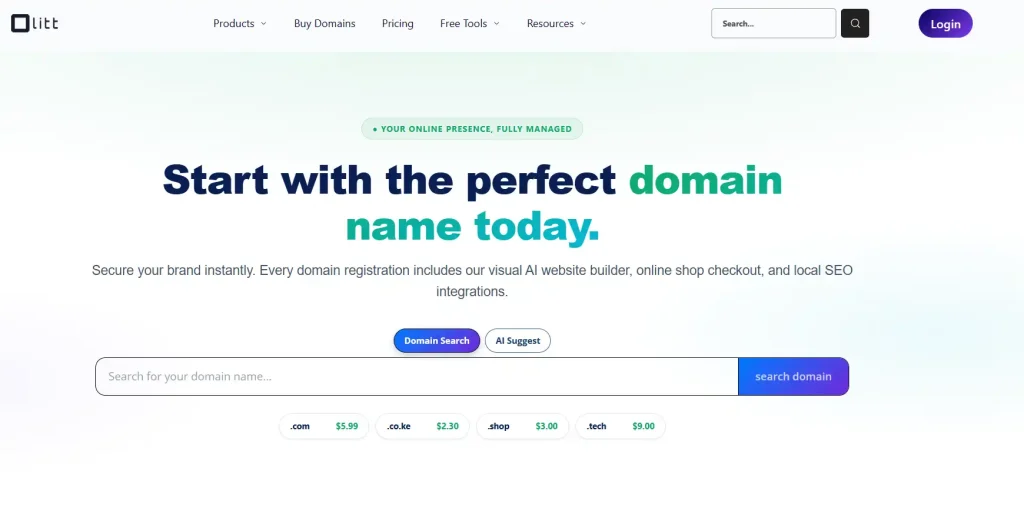
Olitt combines domain search, an AI website builder, and hosting in one account. Search your name there to see whether the .us version is free and what it costs.
When you are ready to buy, follow our steps to register a .us domain. You can compare plans in the Olitt pricing section too.
Frequently Asked Questions
What are the US domain name requirements?
You must meet the nexus rule by being a US individual, a US-formed organization, or a foreign organization with a real US presence. The name must also be 1 to 63 characters, using letters, numbers, and hyphens.
Can someone outside the US register a .us domain?
Only a foreign organization with a real US office or regular lawful US activity can. It must state its country of citizenship.
What characters can a .us domain name use?
Letters a to z, numbers 0 to 9, and hyphens. A hyphen cannot be the first or last character, and accents or non-Latin letters are not supported.
Does .us allow domain privacy?
No. The registry requires public contact data and does not allow privacy or proxy services.
What happens if I fail the nexus check?
The name goes on a 30-day hold. If nothing is fixed in that time, it is cancelled and the fee is not refunded.
Check Your .us Name With Olitt Today
If you meet the US domain name requirements, you can claim your name in a few minutes. Olitt lets you search names, buy domains, and connect them to a website from one account.
Confirm your category, pick a clear name, and secure it before someone else does. Then build your site and give your customers a place to find you.