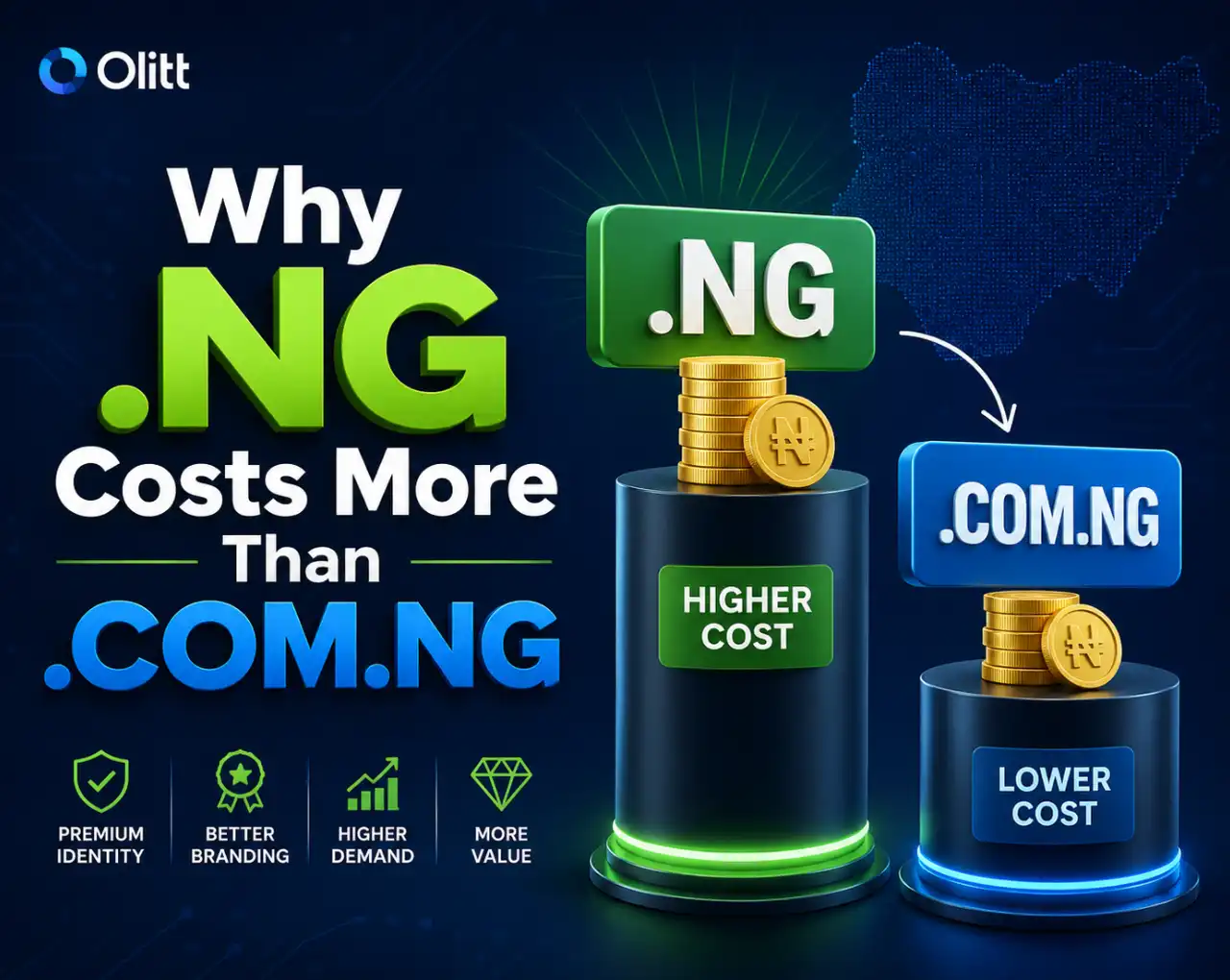

Choosing between .ng vs .com.ng feels like a small decision until you realize it shapes how customers see your brand for years to come.
Many Nigerian business owners get stuck on this exact question. Both extensions look similar on the surface, but they affect branding, trust, memorability, and how easily your business can grow later.
This guide skips the dry technical comparison and focuses on what actually counts when you are picking between .ng vs .com.ng for a real business. You will learn which extension fits different situations, not just how the two are technically different. Just walk with me
Quick Decision Guide
If you only have a minute, start here.
Choose .ng if:
- You want a shorter, premium-looking domain.
- Branding is your top priority.
- You are building a startup or tech company.
- You want a modern, forward-looking online identity.
Choose .com.ng if:
- You are working with a smaller budget.
- You prefer a familiar, widely recognized domain format.
- Your preferred direct .ng domain is already taken.
What Are .NG and .COM.NG Domains?
Both extensions sit under Nigeria’s country-code domain system, managed by the Nigeria Internet Registration Association, known as NiRA.
A .ng domain is a direct, second-level domain, meaning your brand name sits right before .ng, such as brand.ng. A .com.ng domain is a third-level domain, meaning your brand name sits before .com.ng, such as brand.com.ng.
NiRA also oversees related extensions like .org.ng, .edu.ng, .gov.ng, .sch.ng, and .i.ng, which serve more specific purposes covered later in this guide. Around 70 percent of all .ng registrations currently sit under .com.ng, while only 17 percent use the direct .ng format, largely because of cost.
NiRA works with accredited registrars, including Truehost Nigeria and other approved partners, rather than selling domains directly to the public.
Key Differences Between .NG and .COM.NG
Here is how the two extensions actually compare on the things buyers care about most.
| Factor | .NG | .COM.NG |
| Length | Shorter, cleaner | Longer, includes extra characters |
| Branding | Premium, modern feel | Familiar, traditional feel |
| Memorability | Easier to say and recall | Slightly harder due to extra length |
| Availability | More names still open | Many common names already taken |
| Customer perception | Seen as innovative | Seen as established and safe |
| Cost | Higher, roughly 40,000 to 150,000 naira a year | Lower, roughly 8,000 to 15,000 naira a year |
| Ease of typing | Fewer characters to type | More characters, more room for typos |
| Professional appearance | Strong for startups and tech brands | Strong for traditional and local businesses |
| Long-term flexibility | Room to build a distinct national brand | Easier entry point, can upgrade later |
Neither option wins on every factor. The right choice depends on your budget and how you want customers to perceive your brand from the first click.
Which Domain Should You Choose?
Different business types tend to lean toward one extension over the other.
- Startups often choose .ng, since a short, modern domain matches the brand image investors and early customers expect.
- E-commerce stores often choose .com.ng, since customers already trust the familiar .com pattern when entering payment details.
- Small businesses often choose .com.ng for the lower cost, especially in the early stages before revenue is steady.
- Personal brands often choose .ng, since a short domain is easier to put on business cards and social profiles.
- Corporate companies often choose .ng once budget allows, since it signals scale and confidence.
- NGOs typically choose .org.ng instead of either option, which is covered in the next section.
- Freelancers often choose .com.ng for affordability, or .name.ng for an even lower entry cost.
- Professional services often choose .com.ng, since clients associate it with an established, dependable practice.
When Should You Consider Other Nigerian Domain Extensions?
The .ng vs .com.ng comparison covers most commercial cases, but a few specialized extensions fit certain organizations better.
- .org.ng suits NGOs, charities, churches, and community organizations.
- .edu.ng suits universities, colleges, and other educational institutions.
- .gov.ng suits government agencies and public institutions.
- .sch.ng suits primary and secondary schools.
- .name.ng suits personal brands, portfolios, freelancers, and bloggers, and it is the cheapest extension NiRA offers.
- .i.ng suits creative branding, startups, and marketing campaigns that want a distinctive, short web address.
If your organization fits one of these categories, that specialized extension usually signals credibility better than a generic commercial domain would.
Should You Register Both?
For many businesses, registering both .ng and .com.ng makes sense.
Owning both protects your brand from competitors registering the other version and confusing your customers. It also means you capture visitors no matter which extension they happen to type from memory, and you can simply redirect one domain to the other.
Registering both also prepares you for future growth, so you are not stuck negotiating with someone else for your own brand name later. If your budget is tight and your brand name is unusual enough that squatting is unlikely, owning just one extension for now is a reasonable trade-off.
Weigh the combined renewal cost against the risk. A well-known brand name with obvious commercial value is worth protecting on both extensions, while a niche or highly specific business name carries less urgency to double up immediately.
SEO: Does One Rank Better Than the Other?
Google treats .ng and .com.ng the same at a technical level, but that answer misses the bigger picture.
Local SEO benefits from either country-specific extension, since search engines associate both with Nigeria. Brand recognition, click-through rates, and user trust depend more on how memorable and credible your domain looks than on which extension you picked.
Backlinks, content quality, and website performance influence rankings far more than the extension itself. A well-built .com.ng site with strong content will consistently outrank a poorly built .ng site, no matter how premium the shorter domain looks.
Think about it from a searcher’s perspective for a moment. Someone searching for a Lagos accounting firm cares whether the site loads fast, answers their question, and looks trustworthy, not whether the address ends in .ng or .com.ng. Put your energy into the site itself, and let the extension be a branding decision rather than an SEO one.
Common Mistakes When Choosing Between .NG and .COM.NG
A few habits lead business owners to regret their domain choice later.
- Choosing based on price alone, without considering long-term brand fit.
- Ignoring renewal costs, especially since direct .ng renewals run considerably higher than .com.ng.
- Buying a domain name that is hard to spell or pronounce, no matter which extension it uses.
- Forgetting brand protection, and letting a competitor register the extension you skipped.
- Choosing the wrong extension for the business type, such as a charity registering .com.ng instead of .org.ng.
- Registering only one extension when both were realistically affordable.
How to Register a .NG or .COM.NG Domain with Olitt
Getting either domain set up takes just a few steps.
- Search your preferred domain name through Olitt’s domain search tool.
- Check availability for both the .ng and .com.ng versions.
- Add your chosen domain, or both, to your cart.
- Create an account or log in if you already have one.
- Complete payment securely.
- Activate your domain once registration confirms.
- Connect hosting or launch your site with the Olitt AI Website Builder.

If you want a deeper walkthrough of the registration process itself, our full .ng domain registration guide covers each step in more detail.
Frequently Asked Questions
What’s the difference between .ng and .com.ng?
A .ng domain sits directly under the country code, while .com.ng adds an extra commercial layer, making .ng shorter and generally more expensive.
Is .ng more expensive?
Yes. Direct .ng domains typically cost between 40,000 and 150,000 naira a year, compared to roughly 8,000 to 15,000 naira for .com.ng.
Is .ng only for businesses in Nigeria?
No. Any business or individual can register a .ng domain, though it carries the strongest branding value for companies serving the Nigerian market.
Which extension is better for startups?
Most startups lean toward .ng for its short, modern feel, provided the higher renewal cost fits their budget.
Final Recommendation
Choose .ng if branding, memorability, and a modern image matter most to your business right now.
Choose .com.ng if affordability, familiarity, and broad recognition are your bigger priorities. If protecting your brand is a priority over the long run, registering both and redirecting one to the other gives you the safest position either way.
Secure Your Domain Today
Search both the .ng and .com.ng versions of your preferred domain on Olitt, and compare availability before making your final decision.
Register your preferred extension, or both if brand protection is a priority for you, and launch your site with Olitt’s AI website builder, hosting, and business email, all from one platform. Start your domain search on Olitt and lock in your Nigerian web identity today.
Sources: Nigeria’s .ng domain sees more traction, The Guardian Nigeria, .ng domain overview, Wikipedia, NiRA registration data, Economy Post